Sudden Life Changes: 7-Day Reset for Emotional Resilience
Coping with Sudden Life Changes: Practical Steps for Emotional Resilience and Personal Growth
Sudden life changes can feel disorienting—whether it’s a breakup, job loss, relocation, health news, or a shift in family roles. The goal isn’t to “stay positive” on command, but to regain steadiness, make sense of what happened, and choose next steps that protect well-being while supporting growth over time.
What Makes Sudden Change So Hard
Abrupt transitions don’t just disrupt calendars—they disrupt the nervous system, identity, and daily decision-making. Even when a change is ultimately helpful, the body and brain may still respond as if something dangerous is happening.
- The nervous system reads abrupt change as a threat, which can intensify anxiety, irritability, insomnia, and trouble concentrating.
- Loss of predictability can trigger a grief response even when the change is chosen or “for the best.”
- Identity disruption is common: roles, routines, relationships, and future plans may need to be rewritten.
- Decision fatigue often rises because even simple tasks require new mental effort.
- Social friction can increase when support needs rise but others don’t understand the intensity of the transition.
If you’re feeling “off,” that often reflects a normal stress response—not a personal failure. The American Psychological Association’s overview of resilience highlights how resilience is built through skills and supports, not a fixed trait you either have or don’t.
First 72 Hours: Stabilize Before Solving
In the earliest phase, the most helpful question is rarely “How do I fix everything?” A more workable question is: “What helps me get through today without making tomorrow harder?”
- Name the situation in plain language: “A major change happened, and the next step is to stabilize.”
- Prioritize basics: sleep window, hydration, regular meals, and short movement—these reduce stress sensitivity.
- Use a grounding routine (2–5 minutes): slow exhale breathing, noticing five things you can see/hear/feel, or a brief body scan.
- Reduce avoidable inputs for a short period (doomscrolling, alcohol, major purchases, big arguments) to prevent compounding stress.
- Pick one “small controllable” task each day (laundry, shower, a 10-minute walk, answering one email) to rebuild agency.
For additional guidance on coping after difficult events, the National Institute of Mental Health resource on coping with traumatic events offers grounded strategies that can apply to many types of upheaval.
A Simple Framework: Feel, Focus, Forward
When everything feels like it changed overnight, it helps to use a repeatable structure. Think of this as a daily loop rather than a one-time solution.
Feel
Allow emotions without rushing to fix them. Labeling emotions (“sad,” “angry,” “numb”) often lowers intensity over time and makes reactions feel less mysterious.
Focus
Identify what is within control today (health, schedule, boundaries, one conversation) versus what is not (other people’s choices, the past). This reduces the mental tug-of-war that fuels exhaustion.
Forward
Choose one next action aligned with values (safety, stability, connection, learning), not just urgency. Repeating this daily is how resilience tends to form: through steady reps, not a single breakthrough.
Common Emotional Patterns and What Helps
- Shock and numbness: keep routines minimal but consistent; short check-ins with trusted people can help reconnect.
- Anxiety spirals: set “worry windows” (10–15 minutes) and redirect attention to a concrete task afterward.
- Anger: use safe discharge (walking, journaling, strength exercise) and delay major conversations until intensity drops.
- Sadness and grief: allow time-limited grieving rituals (music, memory notes, tears) and balance with gentle structure.
- Guilt and self-blame: write down facts vs. interpretations; ask, “What would be a fair statement about my role?”
If emotions are escalating into feeling unsafe, reach out for urgent help right away. The SAMHSA National Helpline can connect you to support and treatment resources.
A 7-Day Reset Plan (Flexible and Realistic)
This plan is designed to be doable even when your energy and concentration are low. Adjust the pace as needed—skipping a day doesn’t “ruin” the process.
| Day | Small Action | Why It Helps |
|---|---|---|
| 1 | Hydrate + 10-minute walk | Lowers stress arousal and restores a sense of control |
| 2 | Write a one-paragraph summary of what changed | Organizes the story and reduces mental looping |
| 3 | Set a basic sleep/wake window | Improves emotional regulation and decision-making |
| 4 | Ask one person for one specific help | Increases support and reduces isolation |
| 5 | Choose one boundary (time, contact, workload) | Prevents overwhelm and preserves energy |
| 6 | Complete one practical next step | Builds momentum and confidence |
| 7 | Review what worked; plan next 3 days | Turns experience into learning and stability |
Turning Change Into Growth Without Forcing It
When Extra Support Is Needed
A Practical Resource for Daily Guidance
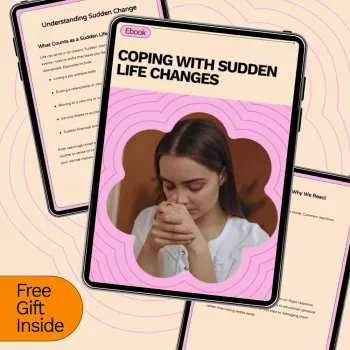
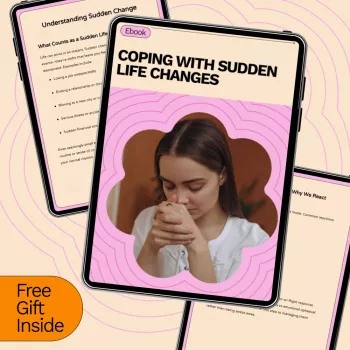
If structured support helps you feel less mentally scattered, a guided routine can make the next step clearer. The Coping with Sudden Life Changes: A Practical Guide for Emotional Resilience and Personal Growth eBook offers step-by-step exercises for emotional steadiness, reframing, and rebuilding resilience after major transitions.
To keep momentum after the first wave passes, Long-Term Growth: Build Habits That Last (Digital Guide) can help turn short-term coping into sustainable routines—especially when motivation comes and goes.
FAQ
How long does it take to adjust to a sudden life change?
It varies by the person and the event: many people stabilize basic functioning in days, adjust routines over weeks, and integrate the experience over months. Setbacks are common, and supportive help often shortens recovery.
What if emotions feel numb or delayed after a major change?
Numbness can be a protective response when the system is overwhelmed. Gentle routines, journaling, movement, and safe connection can help feelings return gradually; seek professional support if numbness persists alongside depression, dissociation, or trouble functioning.
How can growth happen without minimizing what was lost?
Growth and grief can coexist: you can honor what happened while still building a next step. Values-based goals, small experiments, and compassionate self-talk support meaning-making without forcing “silver linings.”











Leave a comment