When “Close Enough” Gear Starts Stealing Your Performance
Training hard should feel challenging—not mysteriously painful, numb, or “off” because something is rubbing, sliding, pinching, or forcing you into an awkward position. The tricky part is that a lot of fit problems don’t scream on day one. They whisper: a hot spot that shows up late, a glove that makes your hands tingle on long sets, a helmet strap you keep “fixing” mid-session, or a brace that feels supportive but changes how you land.
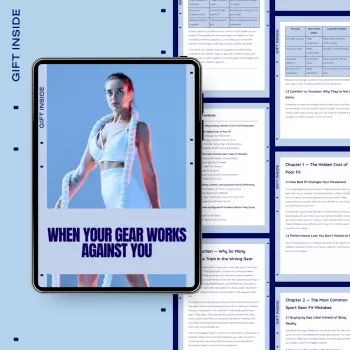
Our team built When Your Gear Works Against You – eBook on Sport Gear Fit Problems, Athlete Equipment Fit Guide, Performance & Injury Prevention Checklist for one purpose: help you spot fit issues early, translate vague discomfort into clear observations, and make smart, fast adjustments before your movement quality (and confidence) takes the hit.
The Hidden Cost of “Almost Fits”
Minor discomfort rarely stays minor. When a pressure point shows up, you naturally compensate—shortening your stride, changing your grip, rotating your hips to avoid a rub point, or bracing your neck against a helmet edge. Those small changes shift load to places that weren’t meant to carry it.
How performance quietly drains
- Reduced power transfer: slipping inside footwear or a pack that bounces forces stabilizing muscles to work overtime.
- Inefficient breathing mechanics: chest straps, shoulder pads, or posture changes can limit rib movement and make “normal pace” feel harder.
- Slower transitions and hesitation: if you don’t trust your footing or grip, you brake earlier, cut shallower, and move cautiously.
Fit problems also sneak in for predictable reasons: you increase volume, swelling changes late in sessions, temperature shifts affect materials, foam packs out, or you buy “standard” sizing that doesn’t match your sport’s demands. A better rule is simple: your gear should support the movement pattern your sport requires—without adding friction, instability, or forced alignment.
Fit Problems You Notice in Training (and What They Usually Mean)
Most issues fall into a few recognizable buckets. When you can name the pattern, you can test the right fix instead of guessing.
For equipment-specific safety guidance, authoritative references like the CDC HEADS UP program (concussion prevention) and the American Academy of Orthopaedic Surgeons (AAOS) guidance on athletic shoes are helpful baselines—especially when you’re deciding whether an issue is “fine to tweak” or “time to change.”
A Fast Gear-Fit Self-Audit (Use Before Your Next Session)
Quick symptoms-to-fix map (first adjustments to test)
| What shows up | What it often indicates | First adjustments to try |
|---|---|---|
| Heel slip / sliding | Too much volume or poor lockdown | Re-lace/lock lacing, change sock thickness, add heel pads, reassess size/width |
| Toe numbness | Forefoot compression or tight closures | Loosen forefoot, widen fit, check toe box shape, re-position insoles |
| Knee pain that appears with certain shoes/braces | Stability or alignment mismatch | Test different support level, check placement/tension, verify sizing and range of motion |
| Hand tingling in gloves / grips | Pressure on nerves or tight cuff | Size up, adjust strap/cuff tension, change grip diameter, reposition padding |
| Chafing at straps/edges | Edge contact + repetitive motion | Reposition, smooth seams, add protective layer, choose different material/shape |
What’s Inside the eBook (So You Can Use It Mid-Training Week)
When Your Gear Works Against You is built like a troubleshooting tool, not a long theory read. You get a practical athlete equipment fit guide centered on problems that actually interrupt training—slipping, pinching, rubbing, instability, and forced mechanics—plus a performance & injury-prevention checklist that turns “something feels wrong” into actionable data.
How to Use the Checklist Week to Week (Without Overthinking It)
Many athletes also benefit from building a small “fit kit”: alternate socks, tape/blister patches, simple padding, spare laces, and a note of settings that work (strap holes, buckle positions). If you’re working on training consistency overall, pairing this with a habit-focused system like Long-Term Growth: Build Habits That Last | How to Focus on Long-Term Growth | Digital Productivity & Success Guide | Instant Download can help you keep your adjustments organized and repeatable.
A Simple Outcome: Cleaner Training Signals, Fewer Preventable Setbacks
FAQ
Can gear fit issues really cause injury, or is it just discomfort?
Yes—repeated friction, compression, and forced mechanics can change how you move and how load gets distributed across joints and soft tissue. Persistent numbness/tingling or any form change that “protects” a painful spot is a warning sign, not something to normalize. Our checklist helps you catch these patterns early and correct them before they compound.
What if the gear feels fine at the start but hurts later in the workout?
Fit can change as you warm up: swelling, heat, moisture, and fatigue all alter how gear sits and how sensitive tissues feel. Use a warm-up re-check to identify exactly when symptoms begin, then adjust one variable at a time (closures, socks, lacing, padding placement) so you can confirm what actually worked.
Is this eBook only about shoes, or does it cover other equipment too?
It’s a general athlete equipment fit guide that applies across major gear interfaces—footwear, helmets, gloves, pads, braces, straps, and more. The troubleshooting framework is designed to be sport-agnostic, so you can adapt it to whatever gear is between your body and the work.