AI Email Subject Lines That Boost Opens and Sales

AI Secrets for Winning Email Subject Lines: A Smart Guide to Higher Opens and More Sales
Email subject lines decide whether a message gets opened, ignored, or deleted without a second thought. An AI email subject line generator can help uncover better angles faster, personalize at scale, and produce testable variations without relying on gut instinct alone. The real advantage comes from pairing AI speed with human judgment: keeping promises clear, matching the reader’s context, and avoiding patterns that hurt deliverability. When done well, stronger subject lines don’t just lift opens—they improve clicks, conversions, and long-term list health. For more guidance, see Go Beyond Open Rates with Generative AI for Email Marketing ….
What Actually Moves Open Rates (and What Doesn’t)
Open rates don’t improve because a subject line is “creative.” They improve when the subject line makes the right person feel like the email is worth their time right now. For further reading, see AI email subject line generator | AI agent – WRITER.
- Relevance beats cleverness: A subject line that matches the reader’s situation (new subscriber vs. repeat buyer) consistently outperforms vague wordplay.
- Clarity first: People decide in seconds. If the topic or value is unclear, the email gets skipped—even if the offer is strong.
- Specificity increases trust: Concrete benefits, numbers, timeframes, and outcomes reduce uncertainty and make the message feel “real.”
- Mismatch costs more than low opens: Clickbait can drive short-term opens but increase spam complaints and damage deliverability over time.
For deliverability-safe sending habits and inbox placement fundamentals, it helps to align with guidance from sources like Google’s email sender guidelines and reputable email testing platforms like Litmus.
A Simple Framework AI Can Generate From: Audience + Offer + Outcome
Most “good” subject lines are just clear decisions made quickly. A reliable way to direct AI (and keep outputs usable) is to define three ingredients.
- Audience: who the email is for (new subscriber, trial user, repeat buyer, dormant lead).
- Offer: what value you’re delivering (discount, new feature, educational tip, limited availability).
- Outcome: what the reader gets (save time, reduce risk, get a faster win, avoid a mistake).
- Add one constraint for focus: a length cap (35–55 characters), no emojis, or include the product category.
- Use one primary goal per email: a single clear action beats a subject line trying to do everything at once.
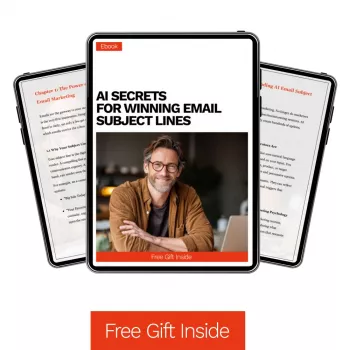
If you want a structured, repeatable playbook to build from, AI Secrets for Winning Email Subject Lines (ebook) turns this framework into practical templates, style variations, and testing rules you can reuse campaign after campaign.
How to Feed an AI Subject Line Generator for Better Outputs
AI outputs are only as strong as the context you provide. If the input is vague, the subject lines will be generic—and “generic” rarely wins an inbox.
- Provide context the AI can’t guess: audience segment, product name, price point, urgency window, and the email’s core promise.
- Include brand guardrails: tone (direct, friendly, premium), forbidden words, and a short list of approved phrases.
- Share proof points: reviews, metrics, “as seen in,” guarantees, shipping timelines, and differentiators.
- Ask for batches: generate 20–40 variations across multiple styles (benefit-led, curiosity-led, social proof, problem/solution).
- Request deliverability-safe versions: avoid spam-triggering patterns like excessive punctuation or misleading “RE:” and “FWD:” lines.
Benchmarks and real-world examples can keep expectations grounded; resources like Mailchimp’s email marketing guidance offer useful baselines for campaign performance and testing ideas.
Subject Line Styles That AI Can Mix and Match
One of AI’s best uses is rapidly producing “style families” so you can test different psychological angles without rewriting from scratch.
| Style | Template | Example |
|---|---|---|
| Benefit-led | Get [outcome] without [pain point] | Get more opens without sounding spammy |
| Specific + time | [Number] ways to [result] this week | 7 ways to lift open rates this week |
| Curiosity + clarity | The [topic] mistake costing [audience] [cost] | The subject line mistake costing stores sales |
| Proof-driven | How [peer group] improved [metric] | How newsletters improved opens with smarter testing |
| Low-friction | A quicker way to [task] | A quicker way to write subject lines that convert |
A Practical Workflow: Generate → Filter → Refine → Test
Common AI Pitfalls (and Quick Fixes)
Using “AI Secrets for Winning Email Subject Lines” as a Repeatable Playbook
- Use AI Secrets for Winning Email Subject Lines (ebook) to build a swipe file of proven patterns tailored to your audience.
- Turn top-performing categories into reusable templates for promotions, launches, newsletters, and reactivation flows.
- Create a pre-send checklist: relevance, clarity, proof, length, and alignment with the email body.
- Apply testing discipline by segment so improvements compound rather than resetting every campaign.
For teams that also care about mindset and consistency—because creative testing requires steady follow-through—Bright Side Up: A Simple Guide to Getting Positive Thoughts Every Day is a quick, practical read for building daily momentum.
FAQ
How long should an email subject line be for mobile inboxes?
A practical target is 35–55 characters (often about 5–9 words), since many mobile inboxes truncate longer lines. More important than a strict limit is making the value clear in the first few words.
Do AI-generated subject lines increase spam risk?
AI itself doesn’t increase spam risk—risky patterns do. Avoid misleading headers, excessive punctuation, and subject lines that don’t match the email content, and keep formatting clean to protect deliverability.
What should be tested first to improve open rates?
Start with the biggest levers: benefit vs. curiosity, specificity (including numbers/time), personalization type, and segment-based messaging. Test one major change at a time so you can clearly attribute the lift.








Leave a comment