A Homework Routine That Actually Sticks: A Simple Checklist System for Kids
Homework time goes smoother when kids know what to expect, you aren’t repeating the same reminders, and teachers see consistent follow-through. Our team uses a simple, repeatable flow—supported by a printable checklist—so your child can practice independence without you becoming the “homework manager” every night.
Start with the goal: less nagging, more independence
Before you change anything, choose one main outcome to focus on for the next two weeks: fewer missing assignments, calmer homework time, or better accuracy. Keeping the target narrow helps you notice what’s working and adjust quickly.
- Define what “done” means in your home: turned in/submitted, checked, packed, and ready for tomorrow—not just “finished.”
- Decide who owns each step: your child does the actions; you handle setup and a quick end-of-routine review.
- Keep the routine consistent on school nights, and run a lighter version on weekends (reading, catch-up, or projects).
Set up the homework zone (before the first worksheet comes out)
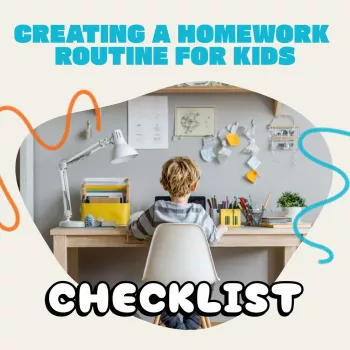
A routine sticks faster when the environment doesn’t fight it. Pick one spot and keep it boring-in-a-good-way: same chair, same surface, fewer distractions.
- Create a small “homework caddy”: pencils, eraser, highlighter, ruler, scissors, glue, scratch paper, and a charger.
- Choose one landing place for school items: a backpack hook/bin, a folder tray, and a spot for library books.
- Remove the biggest time-wasters: TV background noise, a phone within reach, and last-minute supply hunts.
Use the routine flow: Arrival → Reset → Plan → Work → Check → Pack
This sequence reduces decision fatigue. Your child always knows what comes next, and your prompts stay consistent: “Where are you on the checklist?”
Arrival (2–5 minutes)
Snack or water, quick break, bathroom. Meeting basic needs first prevents the “I’m starving!” stall halfway through a math page.
Reset (1–2 minutes)
Clear the desk, open the planner/LMS, gather materials. This is the “launchpad” step that keeps homework from starting in chaos.
Plan (3–5 minutes)
List assignments, estimate time, choose the first task. If your child freezes, you can offer two choices: “Start with the shortest, or start with the hardest?”
Work (10–20 minute blocks)
Use short focus sprints with brief breaks. Most kids do better with two solid blocks than one long session full of interruptions.
Check (3–6 minutes)
Make checking non-negotiable, but quick: confirm directions, name/date, a fast review for obvious mistakes, and submission steps (turn in/upload/attach).
Pack (2 minutes)
Finished work goes into the correct folder, backpack gets packed, and anything needed for tomorrow is set out.
| Time | What Happens | Kid’s Job | Adult Support |
|---|---|---|---|
| 3:30–3:45 | Arrival + reset | Snack, bathroom, unpack folder | Keep it calm; avoid new demands |
| 3:45–3:50 | Plan the list | Write tasks + choose first | Help estimate time if needed |
| 3:50–4:10 | Work block #1 | Focus on first task | Be available; don’t hover |
| 4:10–4:15 | Break | Move, water, quick stretch | Set a timer; keep it short |
| 4:15–4:35 | Work block #2 | Finish or move to next task | Prompt: “What’s next on the list?” |
| 4:35–4:45 | Check + pack | Review, place in folder, pack bag | One final glance for completeness |
Make the checklist work for your child (not the other way around)
- Early elementary: fewer steps, more visuals. Think: “Name on paper,” “Put in folder.”
- Upper elementary: add planning and self-check prompts like “Did I answer every question?”
- Middle school: build in prioritizing (due tomorrow vs. later) and submission checks (upload/attach/turn in).
- If overwhelm shows up, shrink the routine and grow it later: Arrival → Plan → Work → Pack.
- If perfectionism shows up, add a simple rule: “Check once, then move on,” plus a clear stopping time.
Step-by-step: how to introduce the routine in 7 days
Troubleshooting common homework routine problems
Using the routine at home and in the classroom
A printable that keeps the system simple
- How to Create a Homework Routine for Kids – Printable Checklist | Digital Download for Parents & Teachers | Step-by-Step Guide to Better Study Habits
- Long-Term Growth: Build Habits That Last | How to Focus on Long-Term Growth | Digital Productivity & Success Guide | Instant Download
For extra support, it can also help to align homework with healthy daily rhythms and sleep routines. You can find practical, research-informed family guidance at HealthyChildren.org (American Academy of Pediatrics) and sleep habit tips at the CDC sleep hygiene guide. For classroom routines and student responsibility strategies, Edutopia is a strong starting point.
FAQ
What age is a homework routine checklist best for?
A checklist can work from early elementary through middle school when you adjust the steps to match your child’s independence level. Younger kids do best with fewer steps and simple visuals, while older kids benefit from built-in planning, prioritizing, and self-check prompts.
How long should homework time take each night?
Aim for age-appropriate ranges and prioritize quality focus blocks over marathon sessions. Set a consistent stopping time to protect sleep, and if homework regularly runs far past that boundary, it’s worth communicating with the teacher about workload and expectations.
What if a child refuses to start homework?
Keep the entry routine predictable and calm: arrival needs first, then start with the easiest task to build momentum. Use a short timer for the first sprint and keep your prompts limited to the checklist step instead of debating or negotiating.